
The Hidden CRM Errors That Break Your Entire Funnel
Hidden CRM errors quietly break your funnel long before deals stall. Learn which data issues disrupt lifecycle stages, targeting, and outbound performance at scale.
INDUSTRY INSIGHTSLEAD QUALITY & DATA ACCURACYOUTBOUND STRATEGYB2B DATA STRATEGY
CapLeads Team
1/10/20263 min read
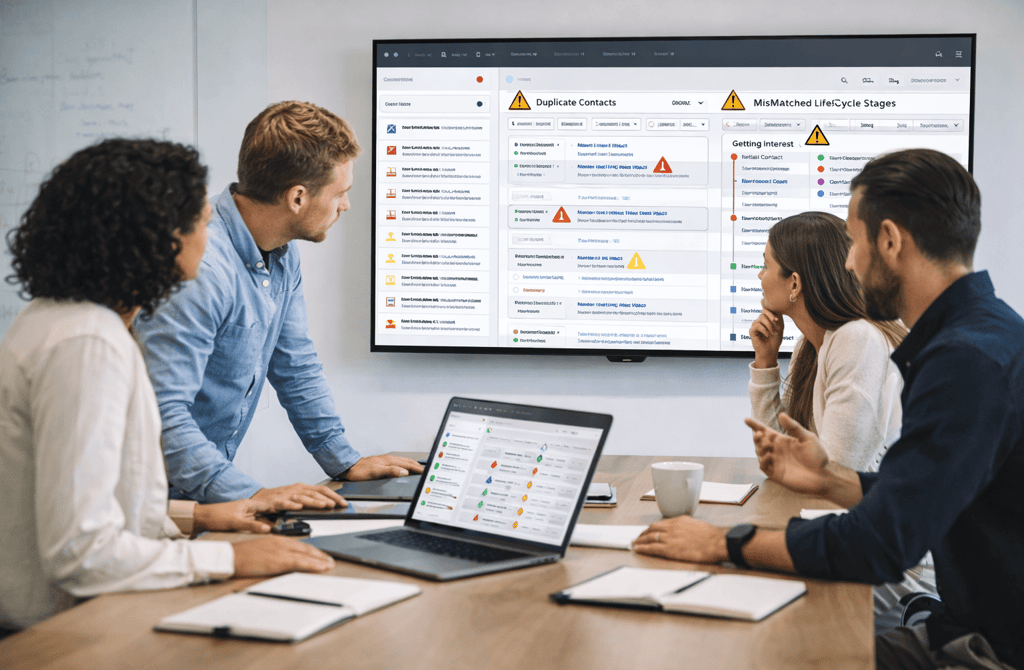
Most teams assume their funnel breaks because of weak messaging, poor follow-ups, or lack of volume. In reality, funnels usually collapse long before prospects ever feel the outreach—inside the CRM itself.
The most damaging CRM problems aren’t obvious. They don’t trigger alerts. They don’t crash systems. They quietly distort how every stage of the funnel behaves, until nothing converts the way it should.
This isn’t about messy dashboards. It’s about invisible errors that compound as outbound scales.
CRM errors don’t stop the funnel — they bend it
The most dangerous CRM issues don’t shut things down. They bend reality just enough to mislead decisions.
Examples include:
Leads marked as “contacted” when no real contact happened
Disqualified accounts slipping back into active sequences
Replies logged without context or intent classification
Each error seems small. Together, they warp funnel behavior so metrics still move—but meaningfully less progress happens.
Teams respond by pushing harder instead of fixing the signal.
Stage misalignment creates false momentum
One of the most common hidden errors is lifecycle stage inflation.
Funnels look healthy when:
MQLs convert quickly on paper
SQL counts grow steadily
Opportunities stay “open” longer than expected
But under the hood, stages are misused. Contacts advance because of automation rules, not buyer behavior. Replies are treated as intent. Opens are mistaken for progress.
This creates a funnel that moves but doesn’t convert.
Founders think the problem is follow-up timing or pitch clarity, when the real issue is that the funnel is measuring motion—not intent.
Duplicate logic fragments buyer history
Duplicate records don’t just create clutter—they fracture context.
When the same buyer exists in multiple CRM records:
Engagement history splits across profiles
Suppression rules fail inconsistently
SDRs unknowingly restart conversations
From the buyer’s perspective, outreach feels disconnected. From the system’s perspective, performance data becomes unreliable.
The funnel doesn’t fail outright. It just starts leaking trust at every step.
Automation magnifies small CRM mistakes
Automation doesn’t fix CRM problems—it magnifies them.
A single bad rule can:
Re-activate cold leads automatically
Push the wrong contacts into new sequences
Advance deals without validation
Recycle stale accounts indefinitely
At low volume, these mistakes are survivable. At scale, they create feedback loops that flood outbound with low-intent activity.
The funnel fills. Replies drop. Conversion timing stretches. Teams blame scale when the real issue is automation acting on flawed data.
Hidden CRM errors break forecasting first
Forecasts are often the first casualty of CRM decay.
When CRM errors accumulate:
Close rates stop matching historical benchmarks
Deal velocity becomes unpredictable
Pipeline coverage ratios lose meaning
Revenue projections swing wildly month to month
This isn’t market volatility. It’s signal corruption.
Leadership decisions become reactive because the funnel no longer reflects buyer reality. Hiring, spend, and outbound strategy are all adjusted based on distorted inputs.
Funnel health depends on CRM truth, not activity
A healthy funnel doesn’t require constant activity—it requires accurate truth at each stage.
That means:
Stages change only when buyer behavior changes
Replies are categorized by intent, not existence
Automation respects lifecycle reality
Old data exits the system instead of recirculating
When CRM truth breaks, funnels don’t collapse loudly. They quietly stop working while appearing active.
Final thought
Funnels fail when CRM errors rewrite reality without anyone noticing. What breaks growth isn’t lack of effort—it’s bad signals driving good decisions in the wrong direction.
When CRM data stays aligned with real buyer behavior, funnels stay honest and scalable.
When hidden CRM errors accumulate, outbound keeps running—but the funnel stops meaning what it says.
Related Post:
Why Buying Committees Require Multi-Contact Targeting Logic
The Data Signals That Reveal a Real Buying Committee
How Missing Roles Break Multi-Contact Outreach
Why Single-Contact Outreach Fails Inside Larger Accounts
The Buying Path Patterns Hidden in Mid-Market Companies
Why Intent Signals Predict Replies Better Than Copy
The Behavioral Clues That Reveal High-Intent Prospects
How Hidden Intent Patterns Shape Cold Email Outcomes
Why High-Intent Leads Respond Faster and More Consistently
The Intent Signals Most Outbound Teams Never Track
Why Reply Rates Depend More on Data Than Messaging
The Hidden Predictors of High Reply Probability
How Lead Quality Shapes Your Reply Rate Curve
Why Clean Lists Produce More Consistent Replies
The Timing Factors That Influence Reply Behavior
Why Data Problems Create Invisible Pipeline Leaks
The Silent Funnel Drop-Offs Caused by Weak Lead Quality
How Bad Data Corrupts Every Stage of Your Pipeline
Why Pipeline Inflation Happens With Outdated Leads
The Hidden Pipeline Leaks Most Founders Never Detect
Why CRM Cleanliness Determines Whether Outbound Scales
Connect
Get verified leads that drive real results for your business today.
www.capleads.org
© 2025. All rights reserved.
Serving clients worldwide.
CapLeads provides verified B2B datasets with accurate contacts and direct phone numbers. Our data helps startups and sales teams reach C-level executives in FinTech, SaaS, Consulting, and other industries.