
What Inbox Providers Infer About Your Lead List
Inbox providers silently judge your lead list. Learn the signals they detect, how these inferences impact deliverability, and why data quality shapes inbox placement.
INDUSTRY INSIGHTSLEAD QUALITY & DATA ACCURACYOUTBOUND STRATEGYB2B DATA STRATEGY
CapLeads Team
12/8/20252 min read
Most founders think inbox providers only look at what you send — your subject line, your copy, your warm-up, or your sending schedule. But in reality, inbox providers also judge who you send to. And they infer a surprising amount about your operation simply by analyzing your lead list.
Every email you send sends a signal. And inbox providers interpret those signals to decide:
Do you belong in Primary, Promotions, or Spam?
Those decisions start long before a human even sees the email.
Inbox Providers Study Patterns, Not Individual Emails
Gmail, Outlook, Yahoo — none of them evaluate your emails one by one. They study patterns at scale:
How many contacts are valid
How many bounce
How fast your list decays
How engaged your contacts are
Whether your data comes from clean, reliable sources
When they see a good pattern, they reward you with placement.
When they see a bad pattern, they restrict you fast.
This is why data quality is not a marketing problem — it’s a deliverability problem.
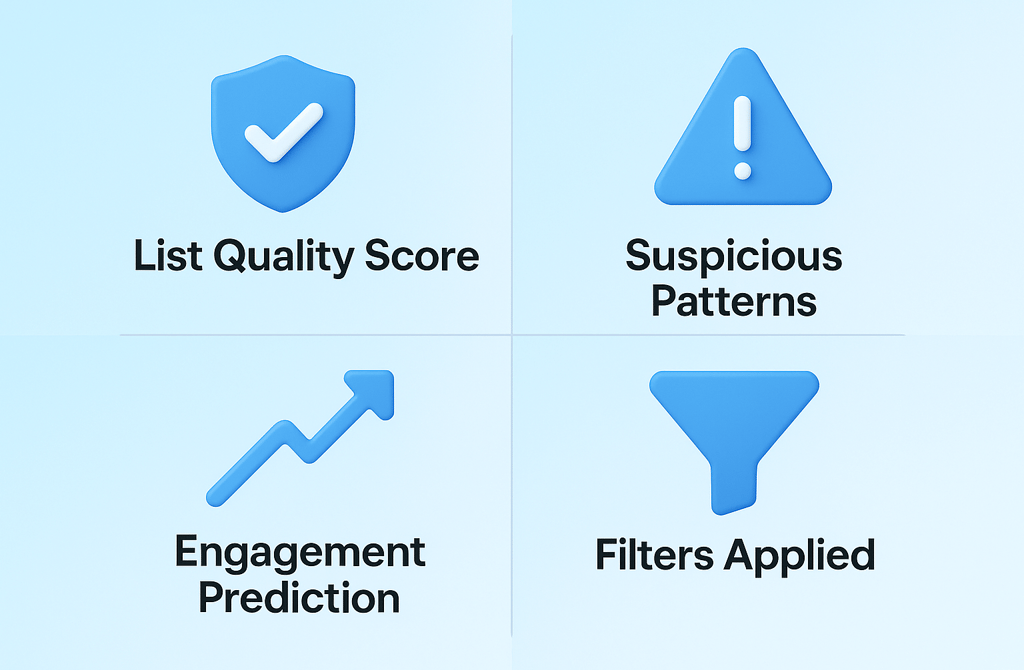
1. List Quality Score: The First Impression
Inbox providers build a silent “trust score” based on your historical behavior.
A clean list with active inboxes signals:
low risk
high sender credibility
consistent engagement
A messy list signals the opposite and triggers filters even before your email goes out.
Your sender reputation is a reflection of your data — not your copy.
2. Suspicious Patterns That Raise Flags
The fastest way to make inbox providers distrust you is through patterns that look automated, careless, or spammy:
High bounce rates
A large batch of outdated contacts
Sudden volume spikes
Repeated sends to dormant inboxes
To an inbox provider, these patterns suggest you’re not maintaining your list — meaning you’re a potential risk.
And risky senders do not get prime inbox placement.
3. Engagement Prediction: The Quiet Algorithm
Inbox providers don’t just look at your past behavior — they predict your future behavior.
They ask: Will this list respond?
If they predict “yes,” your emails get better placement.
If they predict “no,” your emails quietly slide to Promotions or Spam.
Clean, accurate lead lists produce strong open and reply signals.
Outdated lists produce the opposite.
This prediction drives your inbox placement more than your subject line ever could.
4. Filters Applied Based on List Behavior
Once inbox providers decide they don’t trust your list, they apply filters:
Spam filtering
Promotions categorization
Rate limiting
Reduced placement priority
These filters stay active until your sending behavior — and your data — prove otherwise.
This is why some campaigns never recover after a few bad sends.
The problem was never the sequence.
It was the list.
Final Thought
Inbox providers don’t judge your campaigns emotionally. They judge your data mathematically. Your lead list is one of the strongest signals they use to decide whether you earn inbox placement — or lose it.
Strong data gets your emails delivered.
Outdated data gets you filtered before your campaign even starts.
Related Posts
Why Engineering Leads Produce High-Value Replies
The Real State of Construction Leads in 2026
Why Transport & Freight Leads Increase Bounce Risk
Why SaaS Leads Generate Better Deliverability Signals
Why Healthcare Leads Need Strict Email Validation
Why Agency Leads Produce Higher Spam Complaints
The Truth About Manufacturing Lead Data Accuracy
Why HR Recruiter Leads Require More Detailed Enrichment
Why Financial Services Leads Are Hard to Personalize
The Real Data Risks in Facility Management Leads
Why Logistics Leads Bounce More Than Other Verticals
The Industry Factors That Influence Data Freshness
Why the Right Industry List Beats General B2B Databases
The Deliverability Edge You Get From High-Integrity Data
How Data Preparation Changes Your Cold Email Outcome
Why Good Copy Fails When the Lead Data Isn't Prepared
The Data Filters Your Emails Pass Through Before Reaching Inboxes
Why Data Cleaning Should Happen Before Warming Up Domains
How Lead Quality Shapes Your Open Rate More Than Subject Lines
Connect
Get verified leads that drive real results for your business today.
www.capleads.org
© 2025. All rights reserved.
Serving clients worldwide.
CapLeads provides verified B2B datasets with accurate contacts and direct phone numbers. Our data helps startups and sales teams reach C-level executives in FinTech, SaaS, Consulting, and other industries.