
Why Bounce Rate Drops When You Source Better Data
Bounce rates drop fast when your data source improves. Better data removes invalid emails, reduces risk, and protects your sender reputation. Here’s why it works.
INDUSTRY INSIGHTSLEAD QUALITY & DATA ACCURACYOUTBOUND STRATEGYB2B DATA STRATEGY
CapLeads Team
12/9/20253 min read
Bounce rate isn’t just a deliverability metric — it’s a signal.
It tells you whether your outbound system is built on solid ground… or if you're sending cold emails to contacts who were never valid in the first place.
Most founders treat bounce rate as a warmup issue.
They dial up their warmup tool, add more domains, or send lighter campaigns.
But none of that solves the core problem:
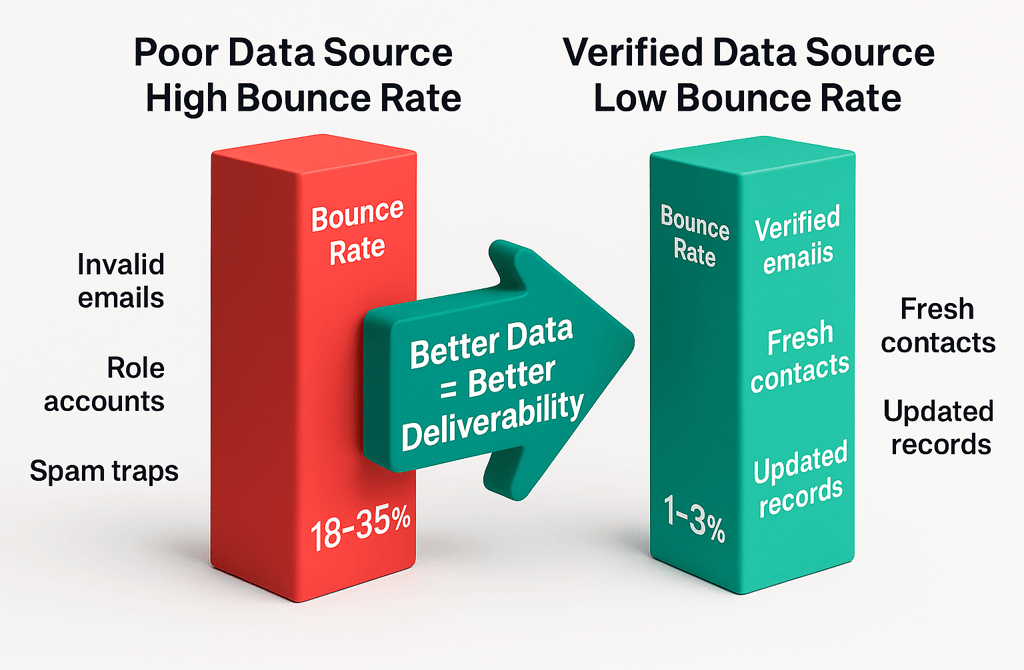
Bad data creates high bounce rates — and good data eliminates them.
Here’s why your bounce rate drops instantly when you source better data.
1. Better data removes invalid and undeliverable emails
The #1 cause of bounces isn’t your domain or your sending tool.
It’s the email itself: invalid, mistyped, or simply non-existent.
Poor data sources usually include:
emails that never existed
domains that don’t accept mail
typo-based errors
recycled spam traps
parked or expired domains
When you switch to a verified data source, these disappear.
Cleaner input → fewer invalid addresses → fewer bounces.
Bounce rate drops because the list itself becomes healthier.
2. You eliminate role accounts that damage deliverability
Role accounts like:
info@
support@
admin@
sales@
…often bounce, auto-reply, or trigger filters.
Bad data sources include them by default because they appear “valid.”
But in outbound, they are reputation poison.
Better data sources scrub these out long before your campaign begins.
That alone can cut bounce rate by 20–40% depending on the industry.
3. Verified domains reduce sudden, silent failures
Some domains technically exist…
…but they’re not configured to receive email.
These are the worst types of bounces because:
tools can’t detect them easily
signals look “valid”
deliverability still tanks
High-quality data providers check:
MX records
SMTP responses
domain configuration
mail server health
That extra layer prevents silent domain failures — and bounce rate drops.
4. Fresh contacts prevent decay-based bounces
Data isn't static.
The contact who was valid six months ago might have:
switched companies
changed roles
lost access
been offboarded
had their mailbox deactivated
All of these cause delayed bounces — the type you only see once a campaign warms up.
Better data sources track activity and recency, giving you active and current contacts.
Bounce rate drops because the list isn’t stale.
5. Data sourcing affects your domain reputation — which affects deliverability
High bounce rates → low reputation → higher future bounce rates.
It becomes a loop.
When you source better data:
sender reputation climbs
ESPs trust your domain
servers stop deflecting your messages
your valid sends stay valid
A clean list protects your domain — which protects your deliverability — which protects your inbox placement.
You don’t just fix bounce rate.
You fix the entire sending ecosystem.
6. Better data reduces the hidden “soft bounces” nobody talks about
Soft bounces come from:
throttling
temporary blocks
greylisting
anti-spam suspicion
Most founders never see these until it’s too late.
Verified data reduces:
high-risk patterns
suspicious domains
spam-trap likelihood
mismatched metadata
That means fewer soft blocks, fewer temporary failures, and smoother sending.
Your bounce rate drops because servers stop treating your outbound as suspicious.
Final Thought
Bounce rate is not random.
It’s a direct reflection of the quality of your data source.
Better data removes invalids, cuts risk, filters role accounts, and aligns your sender reputation with healthy signals — and bounce rate naturally drops.
Clean data makes bounce rates predictable.
Outdated data makes bounce rates spiral out of control.
Related Posts
Why Agency Leads Produce Higher Spam Complaints
The Truth About Manufacturing Lead Data Accuracy
Why HR Recruiter Leads Require More Detailed Enrichment
Why Financial Services Leads Are Hard to Personalize
The Real Data Risks in Facility Management Leads
Why Logistics Leads Bounce More Than Other Verticals
The Industry Factors That Influence Data Freshness
Why the Right Industry List Beats General B2B Databases
The Deliverability Edge You Get From High-Integrity Data
How Data Preparation Changes Your Cold Email Outcome
Why Good Copy Fails When the Lead Data Isn't Prepared
The Data Filters Your Emails Pass Through Before Reaching Inboxes
Why Data Cleaning Should Happen Before Warming Up Domains
How Lead Quality Shapes Your Open Rate More Than Subject Lines
What Inbox Providers Infer About Your Lead List
Why Reply Rates Improve When Your Data Is Pre-Qualified
The Hidden Data Rules Behind Modern Spam Filters
Why Cold Email Isn't Working (And Why Data Is Usually the Reason)
How Data Enrichment Changes Your Cold Email Targeting
Connect
Get verified leads that drive real results for your business today.
www.capleads.org
© 2025. All rights reserved.
Serving clients worldwide.
CapLeads provides verified B2B datasets with accurate contacts and direct phone numbers. Our data helps startups and sales teams reach C-level executives in FinTech, SaaS, Consulting, and other industries.