
Why Data Verification Is Now the First Step in Outbound
Data verification has become the true starting point of outbound. Here’s why verifying leads first protects deliverability, saves time, and improves conversions.
LEAD QUALITY & ACCURACYB2B LEAD QUALITYDATA VALIDATIONCOLD EMAIL STRATEGY
CapLeads Team
11/30/20253 min read
A lot of founders still think outbound starts with writing the email.
You pick an angle, draft a subject line, personalize the opener, and refine the call-to-action.
Only then do you load the leads, hit send, and wait to see what comes back.
But outbound doesn’t work like that anymore.
Today, the first step isn’t writing the message.
It isn’t the framework.
It isn’t even warming your domain.
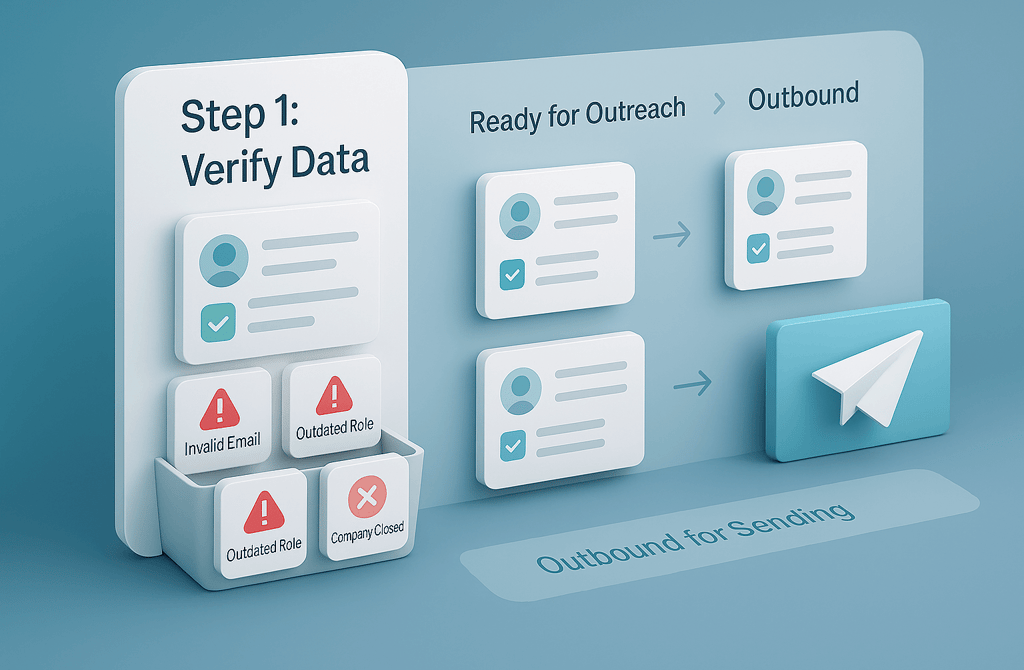
The first step is verifying the data.
And if you skip that step, everything that comes after it begins on shaky ground.
1. Verification Protects Deliverability Before You Even Send
Deliverability used to be something founders paid attention to only after seeing problems.
Now it’s the foundation.
When you send to unverified emails:
Bounce rate spikes
Your domain reputation drops
Fewer emails reach inboxes
Even good leads never see your message
A great message won’t save you from a poisoned sender reputation.
Verified data is what keeps your domain healthy enough to even play the game.
2. Verification Filters Out Leads That Don’t Belong in Your Funnel
Most lead lists look fine at first glance.
The problems only reveal themselves when you dig:
Outdated roles
People no longer at the company
Closed businesses
Duplicates
Invalid emails
Wrong ICP entirely
Without verification, these all slip silently into your outbound sequence.
Verification is the step that says:
“This person is real.
This company exists.
This role is current.
And this email will land.”
Only then does outbound become worth the time you put into it.
3. Verification Saves You From Blaming the Wrong Thing
Bad data doesn’t announce itself.
Instead, it disguises itself as:
Bad copy
Bad offer
Bad subject lines
Bad timing
Bad targeting
You rewrite your emails.
You tweak your angle.
You test new CTAs.
You change frameworks.
All while thinking your messaging is the problem.
In reality, the message never had a chance.
Verification prevents you from chasing the wrong fix.
4. Verification Speeds Up Every Other Step
Outbound relies on momentum.
When data is weak, momentum dies instantly.
You waste hours:
Checking email validity manually
Updating job titles
Replacing closed companies
Guessing who fits your ICP
Cleaning duplicates you should’ve never received
Verification eliminates all of that.
It clears the path so you can focus on what matters:
crafting the message, sending volume, and generating conversations.
Outbound becomes faster, lighter, and dramatically more predictable.
5. Verification Is Now the Normal Standard — Not a “Nice to Have”
A few years ago, verifying data felt optional.
Today, it’s simply the cost of operating.
The companies winning outbound aren’t sending more emails.
They’re sending cleaner ones.
They verify first.
They filter aggressively.
They protect their domain.
They start with the right people.
And because of that, every other part of the process performs better.
Final Thought
Outbound used to begin with copy.
Now it begins with certainty — certainty that the data you’re sending to is real, active, and aligned with who you’re trying to reach.
Clean data is what makes outbound predictable.
Unverified data is what makes it fail before it starts.
Related Posts
The Hidden Data Signals That Decide If Your Email Gets Seen
Why B2B Lead Lists Age Faster Than Founders Expect
The Real Consequences of Using “Almost Valid” Emails
How Data Drift Quietly Destroys Cold Outreach
Why Lead Quality Has Become the New Outbound Currency
The Unspoken Rules of Modern B2B Data Hygiene
What Clean Data Actually Looks Like (Most Founders Get This Wrong)
How Data Freshness Shapes Your Entire Sales Funnel
The Silent Role Data Recency Plays in Outbound Wins
Why Accurate Contact Data Beats Personalization Hacks
How Premium Data Reduces Cold Email Stress
The Invisible Math Behind Validated Lead Lists
The Data Mistakes That Kill Pipeline Before It Starts
Why Job-Change Tracking Matters More Than You Think
The Difference Between Clean Data and Conversion-Ready Data
How to Build a Lead List That Stays Fresh for Months
The Data Foundations Every Outbound System Should Have
Why Bad Data Feels Like A Bad Copy (But It Isn't)
How to Stop Wasting Time on Weak Prospect Data
Connect
Get verified leads that drive real results for your business today.
www.capleads.org
© 2025. All rights reserved.
Serving clients worldwide.
CapLeads provides verified B2B datasets with accurate contacts and direct phone numbers. Our data helps startups and sales teams reach C-level executives in FinTech, SaaS, Consulting, and other industries.