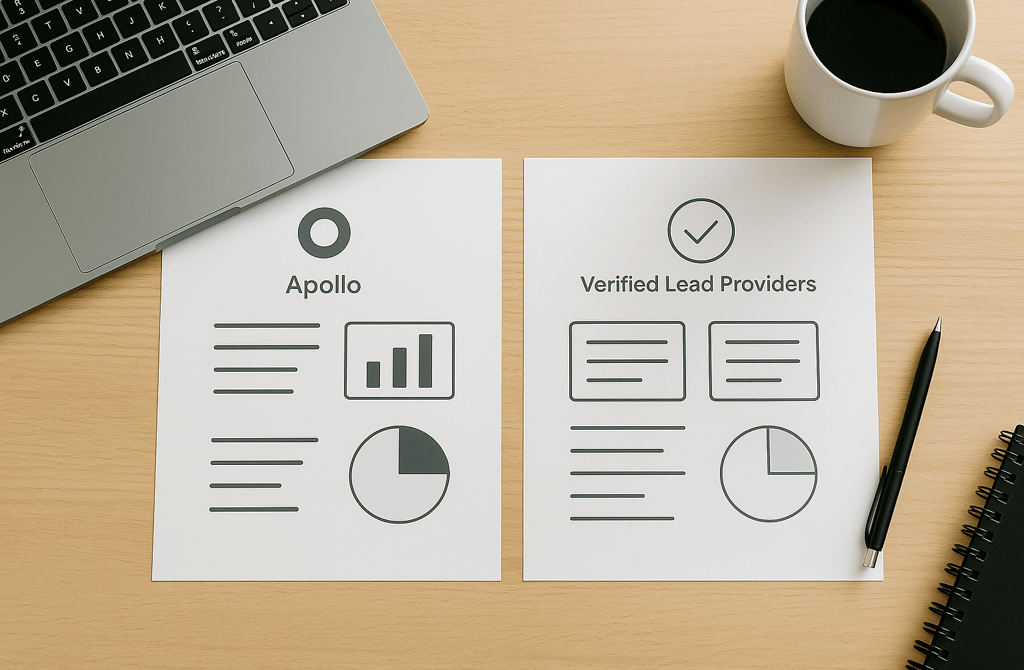
Apollo vs Verified Lead Providers: What Most Buyers Miss
Apollo is powerful, but it works very differently from verified lead providers. Here’s what most buyers miss when comparing massive databases to fully validated data.
LEAD BUYINGLEAD PRICINGB2B DATA QUALITYLEAD PROVIDER COMPARISONS
CapLeads Team
11/26/20253 min read
Every founder comparing lead providers eventually asks the same question:
“Why should I buy verified leads when Apollo exists?”
It’s a fair question.
Apollo is huge, has millions of contacts, and offers an entire sales workflow in one platform.
But comparing Apollo to a verified lead provider is like comparing a search engine to a curated research team. They solve different problems, and buyers often misunderstand where each one fits.
To make the right decision, you need to understand what Apollo actually gives you — and what verified providers deliver that a massive database simply can’t.
This isn’t about which one is “better.”
It’s about what most buyers never realize until after they’ve used both.
1. Apollo Wins on Volume — Verified Providers Win on Accuracy
Apollo’s biggest strength is scale.
Millions of contacts.
Thousands of filters.
All searchable instantly.
But that volume comes with reality:
Large databases are constantly updated and scraped, which means:
enrichment can lag
titles change fast
some data ages before refresh
validation can’t keep up with turnover
Verified lead providers work the opposite way.
Instead of billions of records, they focus on curated, validated segments where:
every email is checked
formatting is cleaned
outdated records are removed
titles match real roles
phone numbers are screened
Apollo gives you access.
Verified providers give you accuracy.
Most buyers don’t expect this difference — until they start sending campaigns.
2. Apollo Is a Tool — Verified Providers Are a Data Source
Apollo is an all-in-one platform:
search engine
email sequencing tool
CRM-like interface
enrichment engine
workflow builder
Its business model is software-first.
Verified providers focus on one thing:
delivering clean, dependable data you can trust outside the tool.
The difference matters when you’re running cold outreach at scale.
Software helps you automate.
Data determines whether the automation actually works.
Many founders mix the two, then wonder why their bounce rate spikes.
3. Apollo Refreshes Broadly — Verified Providers Validate Deeply
With a dataset that massive, Apollo updates data in large waves.
But deep validation — multi-layer verification, manual checks, phone review, catch-all processing — isn’t realistic at that scale.
Verified providers can do things Apollo can’t afford to do per record:
multi-tool cross validation
manual role verification
job-title logic checks
industry alignment
removing risky domains
hand-cleaning edge cases
Apollo updates fast.
Verified providers validate deeply.
These are two different strengths.
4. Apollo Works for Exploration — Verified Leads Work for Outbound That Must Perform
Apollo is amazing for:
researching new markets
exploring ICPs
mapping organizational roles
building initial prospect lists
getting a feel for the size of a segment
But when you’re ready for:
consistent inbox placement
low bounce rates
cleaner targeting
better reply rates
safer domain reputation
Verified leads outperform a mass database every time.
Because outbound isn’t won by sending more emails — it’s won by sending to better contacts.
5. Apollo’s Enrichment Is Good — But It’s Not Always “Verified”
Apollo enriches using automated systems at scale.
This is normal for big databases.
But “enriched” doesn’t mean:
validated
deduped
cross-matched
phone-confirmed
ICP-filtered
manually reviewed
Verified providers do enrichment one layer at a time — sometimes with human oversight, sometimes with multi-pass tooling.
The difference shows up directly in reply rates.
6. Apollo Pricing Rewards Quantity — Verified Pricing Rewards Precision
Apollo’s model is subscription-based:
unlimited search
unlimited filtering
contact reveals
sequencing
Great for quantity-focused teams.
Verified providers price based on:
freshness
validation depth
enrichment
persona specificity
risk removal
Great for teams that care about results, not volume.
Apollo = broad.
Verified = focused.
Most buyers skip this nuance.
7. They’re Not Competitors — They’re Complements
Here’s the part most people never consider:
Apollo and verified lead providers serve different stages of your outbound engine.
A lot of smart teams use them together:
Use Apollo to explore a market
Use verified leads to run high-performance campaigns
Use Apollo’s sequencing for delivery
Use verified lists to protect domain health
No conflict — just two tools handling different jobs.
The problem only appears when founders expect Apollo’s massive database to behave like a boutique validation shop.
Or expect a verified provider to behave like a SaaS data platform.
Once you see the difference, the decision becomes obvious.
Final Thought
Apollo is unbeatable for scale and search. Verified providers excel at accuracy and deliverability. The smartest teams don’t choose one over the other—they choose the right tool for the right job.
Clean, validated, deeply-checked data protects your outbound from expensive mistakes.
Outdated, scraped-at-scale data makes even the strongest outreach platform struggle to perform.
Related Posts
The Most Requested B2B Industries for Lead Buying in 2026
High-Value Industries That Respond Best to Cold Email
Why Healthcare & Medical Leads Require More Validation
The Fastest-Growing B2B Markets for 2026 (Based on Lead Demand)
Why Construction Leads Are Hard to Validate — And How CapLeads Does It
Global Tech Leads: What Makes Them Expensive but Worth It
Professional Services Leads: Why They Deliver Better Conversations
Manufacturing & Industrial Leads: What Smart Buyers Look For
Why Global BPO Leads Are Exploding in Demand
Why Lead Prices Are Rising in 2026 (And How to Buy Smart)
Cost-Per-Lead vs Cost-Per-Reply: Which Metric Should You Track?
Why Some Industries Have More Expensive Leads Than Others
The Real Cost of Data Validation: What Providers Don’t Tell You
The Economics of B2B Lead Buying (Explained Simply)
Are You Overpaying for B2B Leads? Signs You’re Getting Ripped Off
The Hidden Costs Inside “Cheap Lead Providers”
Why Price Shouldn’t Be Your First Filter When Buying Leads
Lead Pricing Models Explained: Per Lead, Per Batch, Per Role
Why Verified Leads Can Still Be Affordable If You Know Where to Look
Connect
Get verified leads that drive real results for your business today.
www.capleads.org
© 2025. All rights reserved.
Serving clients worldwide.
CapLeads provides verified B2B datasets with accurate contacts and direct phone numbers. Our data helps startups and sales teams reach C-level executives in FinTech, SaaS, Consulting, and other industries.